


Cochlear Implants Explained: How They Work
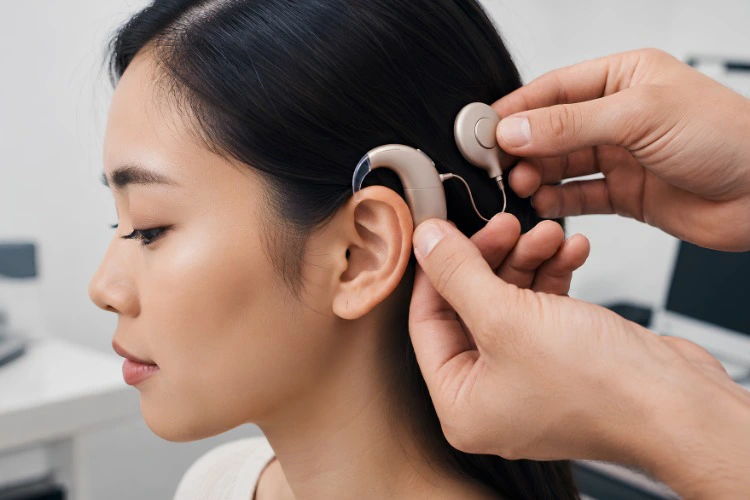
What Is a Cochlear Implant and How Does It Work?
Being told that hearing aids are no longer enough can feel overwhelming.
Whether you're exploring options for your child, a parent, or yourself, it's natural to have questions. What exactly is a cochlear implant? How does it work? Will hearing sound normal again? And who is actually suitable for one?
Understanding cochlear implants is the first step towards making an informed decision.
In this guide, we'll explain how cochlear implants work, who they are designed for, and what you can realistically expect throughout the journey—from assessment to hearing rehabilitation.
A Cochlear Implant Works Differently from a Hearing Aid
This is the most common misunderstanding. People assume a cochlear implant is just a more powerful hearing aid. It's not. The two devices work in completely different ways.
A hearing aid amplifies sound. Think of it like turning up the volume on a speaker. If the speaker is damaged, louder volume just gives you louder distortion.
A cochlear implant skips the damaged part entirely. It converts sound into electrical signals and sends those signals straight to the hearing nerve. It doesn't make sound louder. It creates a brand-new pathway for sound to reach the brain.
According to the U.S. National Institute on Deafness and Other Communication Disorders, over one million people worldwide use cochlear implants today. That number keeps climbing as the technology improves and candidacy criteria broaden.
How does a cochlear implant work?
One simple way to understand it is to imagine your ear as a piano.
Sound waves come in and press different "keys" — tiny hair cells inside your cochlea — that send musical signals to your brain. When those hair cells are damaged or missing, the piano has broken keys. No matter how hard you press, nothing plays.
A cochlear implant is like replacing the broken piano with an electronic keyboard. It doesn't sound exactly the same as the original piano. But it plays music. And over time, your brain learns to love the new instrument.
Here's the step-by-step process:
- Sound arrives. The external microphone picks up sounds from the environment.
- Sound gets processed. The speech processor (worn behind the ear) converts those sounds into digital signals.
- Signals cross the skin. The processor sends the digital code to the internal implant via a magnetic transmitter coil.
- Electrical stimulation happens. The implant converts the code into electrical pulses and sends them along an electrode array sitting inside the cochlea.
- The brain hears. Those electrical pulses stimulate the auditory nerve directly, and the brain interprets them as sound.
The whole thing happens in milliseconds. You speak, the implant user hears — almost in real time.
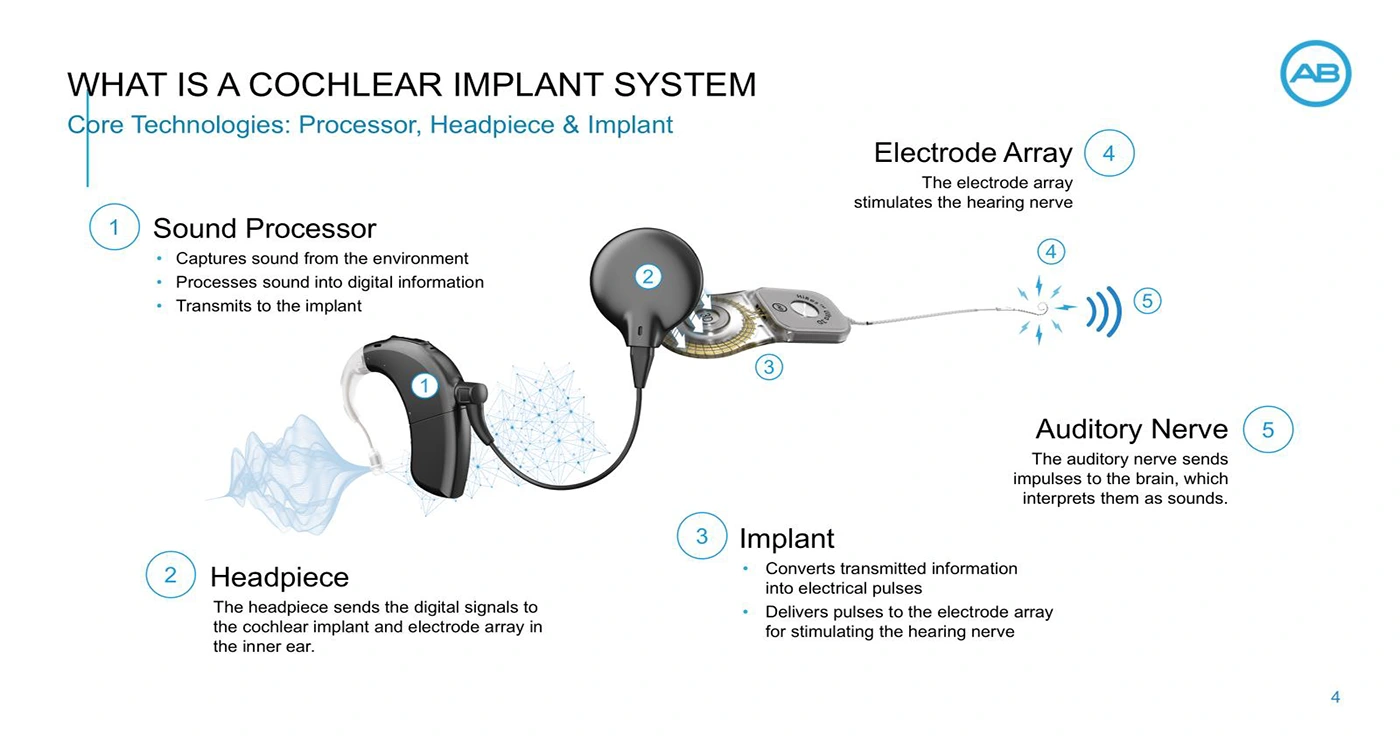
Parts of a cochlear implant
A cochlear implant has two main sections: the external part you can see and the internal part placed during surgery. As Johns Hopkins Medicine explains, the surgery itself typically takes two to four hours and is performed under general anesthesia.
Here's a breakdown:
| Component | Location | What it does |
|---|---|---|
| Microphone | External (behind the ear) | Picks up environmental sounds |
| Speech processor | External (behind the ear or off-ear) | Converts sound into digital code |
| Transmitter coil | External (on the head, held by magnet) | Sends coded signals through the skin |
| Receiver-stimulator | Internal (under the skin behind the ear) | Receives signals and converts them to electrical pulses |
| Electrode array | Electrode array Internal (inside the cochlea) | Delivers electrical pulses to the auditory nerve |
The external sound processor is easy to remove when needed, such as during sleep or showering. With a waterproof accessory, you can even wear it while swimming
Modern processors are sleek and small. Some sit entirely off the ear — no behind-the-ears hook at all. The technology has come a long way from the bulky body-worn devices of the 1980s.
What Can You Expect When a Cochlear Implant Is Activated?
Every person's experience is different, but it's important to understand that hearing through a cochlear implant is a learning process.
When the implant is first activated, sounds often don't resemble natural hearing. Many people describe voices as robotic, electronic, or unfamiliar.
This is completely normal.
Over time, with consistent device use and auditory rehabilitation, the brain gradually learns to interpret these new electrical signals as meaningful sound.
Your brain has been rewired to interpret electrical signals instead of acoustic ones. That takes time. The American Speech-Language-Hearing Association notes that auditory rehabilitation and consistent wear are essential for the brain to adapt to the new signal.
Here's a rough timeline of what many users experience:
- Week 1–2: Sounds are strange, mechanical; complex speech is hard to distinguish. Many people feel overwhelmed.
- Month 1–3: Voices start sounding more natural. Environmental sounds become recognisable.
- Month 3–6: Speech comprehension improves significantly, especially in quiet settings.
- Year 1 and beyond: Most users report that they "forget" the sound is electrical. It just becomes their version of hearing.
Children implanted early — particularly before age three — often develop spoken language on par with their hearing peers, according to research published by the Ear Foundation. Adults who lost hearing later in life tend to adapt faster than those who were born deaf, because their brains already have a "sound library" to reference.
The key ingredient? Commitment to rehabilitation. A cochlear implant is not a set-and-forget device. It's a partnership between technology, therapy, and the brain's remarkable ability to adapt.
Who are cochlear implants for?
Not everyone with hearing loss is a candidate. Cochlear implants are typically considered when hearing aids no longer provide enough benefit.
General candidacy guidelines include:
- Adults with severe to profound sensorineural hearing loss in both ears who score poorly on sentence recognition tests even with properly fitted hearing aids
- Children as young as nine to twelve months with profound hearing loss who are not making expected progress with hearing aids
- People with progressive hearing loss whose hearing has declined beyond what amplification can support
The evaluation process involves detailed hearing tests, medical imaging, and consultations with an audiologist and an ENT surgeon. It's thorough — and it should be. Surgery is involved, and the team needs to confirm that the benefits will outweigh the risks.
There are also hybrid options now for people with residual low-frequency hearing but no high-frequency hearing. These devices combine a cochlear implant with acoustic amplification in the same ear.
Every case is different. That's why a proper assessment is the critical first step.
Cochlear Implants Are Part of a Hearing Journey
Many people assume that cochlear implant surgery is the final step.
In reality, it marks the beginning of a new hearing journey.
Following surgery, recipients attend programming appointments—often called "mapping" sessions—where the sound processor is gradually adjusted to suit their hearing needs. Listening skills continue to improve through regular use, follow-up appointments and, where appropriate, auditory rehabilitation and speech therapy.
Every person's progress is different, but ongoing support from audiologists, therapists and family members plays an important role in helping implant recipients achieve the best possible outcomes.
Understanding Whether a Cochlear Implant Is Right for You
Every hearing journey is unique.
For some people, hearing aids continue to provide excellent benefit. For others, a cochlear implant may offer greater access to speech and everyday communication.
The first step is always a comprehensive hearing assessment.
At 20dB Hearing, our certified audiologists work closely with individuals and families to understand their hearing needs, evaluate hearing aid benefit and provide guidance on whether a referral for cochlear implant candidacy assessment may be appropriate.
Our role is to help you understand your options, answer your questions and support you in making informed decisions with confidence.
If you or someone you love has been struggling despite wearing hearing aids, we're here to help.
Book a hearing assessment with 20dB Hearing and take the first step towards understanding the most appropriate hearing solution for your needs.