




Adult Hearing Test in Malaysia: What to Expect During Your Hearing Assessment
Adult Hearing Test in Malaysia: What Actually Happens During A Hearing Assesment
You've been thinking about getting your hearing checked. Maybe you've been asking people to repeat themselves. Maybe the television volume keeps creeping up. Or perhaps someone close to you has gently mentioned that your hearing doesn't seem quite the same.
Yet many people delay booking a hearing assessment because they simply don't know what to expect.
Will it hurt? How long will it take? What happens if hearing loss is detected?
The good news is that a professional hearing assessment is straightforward, comfortable and designed to give you answers—not uncertainty.
Here's exactly what happens during an adult hearing assessment at 20dB Hearing, so you can walk into your appointment with confidence.
Who should actually get tested
Here's the uncomfortable truth: hearing loss sneaks up on you. It doesn't arrive overnight like a toothache. It tiptoes in over years, and your brain quietly compensates. By the time you notice, you may have been missing sounds for a long time.
The World Health Organization recommends that adults get a baseline hearing check as part of routine health care. After that, how often should adults get their hearing tested? A good rule of thumb:
- Every 10 years until age 50
- Every 3 years after age 50
- Immediately if you notice changes — difficulty following conversations in noisy places, ringing in your ears, or people sounding "muffled"
If you work in a noisy environment — construction, manufacturing, entertainment — you should be getting annual checks. That's not just good practice. Malaysian occupational health guidelines require it.
Don't wait for a problem to become obvious. The earlier hearing loss is detected, the more can be done about it.
The full walkthrough: what happens during a hearing test
This is the part most people want to know. So let's walk through it — the whole appointment, from the moment you sit down.
Step 1: Your Hearing Story
Your audiologist starts by asking questions. Simple ones. When did you first notice changes? Does hearing loss run in your family? Have you been exposed to loud noise? Do you take any medications?
This isn't small talk. Certain medications, like some antibiotics and chemotherapy drugs, are known to be ototoxic — meaning they can damage hearing. Your medical history helps the audiologist understand what they might find.
Step 2: Otoscopy (ear examination)
Next, they'll look inside your ears using a handheld device called an otoscope. They're checking for earwax blockage, infections, eardrum perforation, or anything unusual in the ear canal. It doesn't hurt. You'll feel a slight pressure, like wearing an earbud.
If there’s excessive wax or special conditions such as infections, you might be referred for medical treatment before the next step.
In some conditions, the audiologist might carry out a special test, Tympanometry to check the condition of your ear drum.
Step 3: Pure tone audiometry (PTA)
This is the main event — the part most people picture when they think "hearing test."
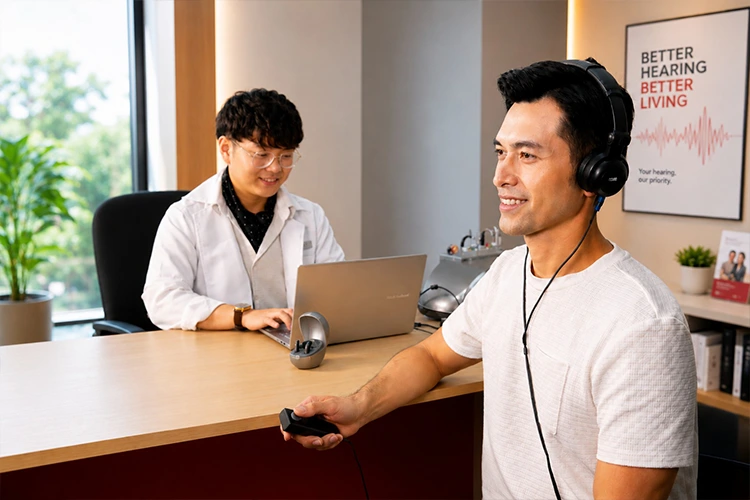
You'll sit in a soundproof booth and wear headphones. The audiologist plays a series of tones at different pitches and volumes. You press a button or raise your hand each time you hear a sound. That's it.
The test measures the softest sounds you can hear across a range of frequencies. It covers both air conduction (sound through headphones) and bone conduction (sound through a small vibrating device placed behind your ear). Together, these reveal not just whether you have hearing loss, but what type.
The whole PTA takes around 15–20 minutes.
Step 4: Results discussion Once testing is done, your audiologist will show you an audiogram — a chart that maps your hearing ability across frequencies. They'll explain it in plain language:
- What's normal and what isn't
- Whether the loss is in one ear or both
- What type of hearing loss you have (sensorineural, conductive, or mixed)
- What your options are — whether that's monitoring, medical referral, or hearing aids
The entire appointment, from walking in to walking out, typically takes 45 minutes to an hour.
No needles. No pain. No discomfort. Just listening to sounds and answering questions.
What Happens After Your Hearing Assessment?
Every hearing assessment is unique.
Some people discover that their hearing is completely within the normal range, leaving with reassurance and a useful baseline for future comparisons.
Others may simply require periodic monitoring or advice on protecting their hearing from further changes.
If hearing loss is identified, your audiologist will explain your results in clear, easy-to-understand language and discuss the most appropriate next steps based on your individual hearing needs. Depending on your assessment, this may include hearing rehabilitation, hearing solutions, or referral to an ENT specialist where appropriate.
Our goal isn't simply to identify hearing loss—it's to help you better understand your hearing health and recommend the most suitable care for your lifestyle.
Frequently Asked Question
How Much does a hearing assessment cost?
The type of hearing assessment recommended depends on your hearing concerns and individual needs.
To ensure you receive the most appropriate assessment, we encourage you to contact your nearest 20dB Hearing centre. Our team will be happy to advise you on the assessment options available and answer any questions before your appointment.
Common fears (and why they’re unfounded)
Most people who delay a hearing test aren't lazy. They're nervous. Let's tackle the big worries head-on.
"What if they tell me I need hearing aids?”
They might. But that's information, not a sentence. Knowing gives you options. Not knowing just lets things get worse. Untreated hearing loss has been linked to faster cognitive decline and increased risk of dementia, according to a Lancet Commission report.
"I'm too young for a hearing test."
Hearing loss affects people of all ages. Noise exposure from earbuds, concerts, and workplace environments means younger adults are increasingly at risk. Age is not the only factor.
"The test will be awkward or embarrassing."
It's a private, one-on-one session in a quiet room. Nobody is watching. Nobody is judging. Your audiologist does this dozens of times a week.
"I'll be pressured to buy something."
A good audiologist presents findings and recommendations. The decision is always yours. And if your hearing turns out to be normal? You walk out with peace of mind and a baseline for future comparison.
Book your test at a branch near you
You now know exactly what happens during a professional hearing assessment.
From your initial consultation to understanding your results, every step is designed to give you greater clarity about your hearing health and the confidence to make informed decisions.
At 20dB Hearing, our certified audiologists provide personalised hearing assessments using professional diagnostic equipment across more than 35 hearing care centres throughout Malaysia.
Whether you've recently noticed changes in your hearing or simply want peace of mind, we're here to guide you every step of the way.
Book your hearing assessment with your nearest 20dB Hearing centre today and take the first step towards better hearing.