




Hearing Loss and Dementia: What the Research Shows
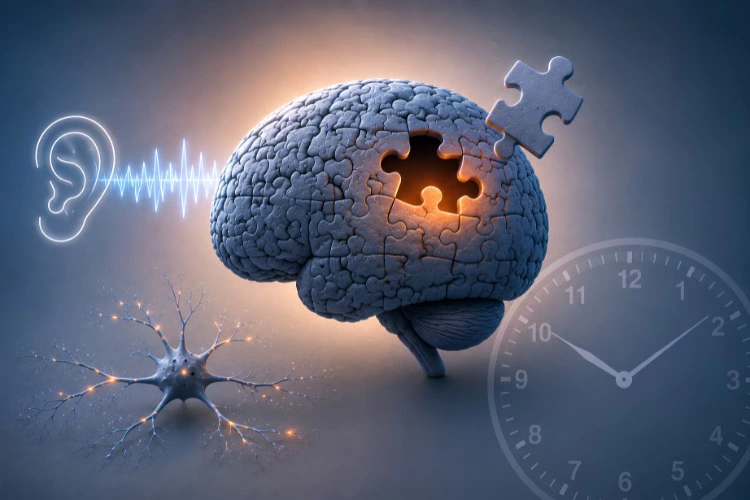
Hearing Loss and Dementia: What the Research Shows (And Why Your Family Should Care)
Your grandmother doesn't have dementia. She just can't hear you.
At least, that's what the family keeps saying. She asks you to repeat yourself three times. She nods along at dinner without really following. She's pulled back from conversations, from gatherings, from life.
And everyone chalks it up to age.
But here's something most families in Malaysia don't realise. That slow withdrawal? That creeping forgetfulness? It might not start in the brain. It might start in the ears.
The connection between hearing loss and dementia is no longer a theory. It's one of the most well-documented findings in modern brain health research. And the good news is, it's something you can actually do something about.
Your ears feed your brain
Let's start with the basics.
Your brain doesn't just process sound. It depends on it. Every conversation, every background noise, every passing motorbike — your brain uses all of that to stay sharp, active, and engaged.
When hearing fades, the brain doesn't just lose volume. It loses stimulation.
Think of it like a muscle, you stop exercising. The auditory cortex — the part of the brain that processes sound — starts to deteriorate. Other areas pick up the slack, pulling resources away from things like memory and thinking.
Researchers call this "cognitive load." When you strain to hear, your brain spends so much energy just decoding words that it has little left for understanding or remembering them. That's why hearing loss and memory problems so often walk hand in hand.
There's also the social angle. People who can't hear well tend to withdraw. They skip family dinners. They stop calling friends. And social isolation is itself a well-known accelerant of cognitive decline.
So you end up with a triple threat:
- Brain underload — less auditory input means less neural stimulation
- Brain overload — straining to hear drains cognitive resources
- Social isolation — withdrawal removes the brain's most powerful exercise: human connection
None of these alone leads to dementia. But together, they create the perfect conditions for it.
The Lancet said it plainly
In 2020, The Lancet Commission on dementia prevention published a landmark report. It identified 12 modifiable risk factors for dementia — things people can actually change.
Hearing loss topped the list.
Not smoking. Not obesity. Not physical inactivity. Hearing loss. It accounted for the largest share of potentially preventable dementia cases, responsible for up to 8% of the total risk.
Let that number sink in. Of all the things within our control, addressing hearing loss offers the single biggest opportunity to reduce dementia risk across a population.
The report was clear: treating hearing loss, especially in midlife (ages 40–65), could prevent or delay a significant number of dementia cases worldwide. The researchers didn't mince words. They called hearing loss intervention one of the most impactful public health strategies available.
And yet, most people still treat hearing loss as a minor inconvenience. Something to deal with "later." Something that's "not that bad yet."
Meanwhile, the brain keeps quietly losing ground.
Can hearing aids prevent dementia?
This is the question every family asks. And for years, the honest answer was: "We think so, but we need more proof."
Then the ACHIEVE trial happened.
The ACHIEVE study (Aging and Cognitive Health Evaluation in Elders) was a large-scale, randomised controlled trial — the gold standard in medical research. Published in The Lancet in 2023, it followed nearly 1,000 older adults over three years.
The results were striking. Among participants who were at higher risk for cognitive decline,
Nearly half.
That's not a cure. Nobody is claiming hearing aids prevent dementia outright. But slowing cognitive decline by that much? That could mean years of sharper thinking. Years of independence. Years of being present with your family.
The cognitive decline hearing loss connection isn't just correlational anymore. We now have interventional evidence showing that treating hearing loss changes the trajectory of brain health.
Here's what the research tells us at a glance:
| Finding | Source | Key Takeaway |
|---|---|---|
| Hearing loss is the #1 modifiable dementia risk factor | Lancet Commission, 2020 | Accounts for up to 8% of preventable cases |
| Hearing aids slowed cognitive decline by 48% in at-risk adults | ACHIEVE Trial, 2023 | Strongest interventional evidence to date |
| Untreated hearing loss doubles dementia risk over 10 years | Johns Hopkins research | Risk increases with severity of hearing loss |
Research from Johns Hopkins has also shown that even mild hearing loss doubles the risk of dementia, with the risk tripling for moderate loss and increasing fivefold for severe loss. The relationship is dose-dependent. The worse the hearing loss, the greater the risk.
This isn't about hearing anymore
Let's be honest about what this article is really about.
It's not about hearing aids. It's not about audiograms or decibel levels. It's about your mother still recognising your children in five years. It's about your father staying sharp enough to live on his own. It's about protecting the people you love from something that creeps in so slowly nobody notices until it's too late.
Most families we see at 20dB Hearing don't come in because of hearing. They come in because of everything else hearing loss has taken away. The conversations. The confidence. The connection.
And now we know it can take cognition too.
The frustrating part? Hearing loss is incredibly treatable. A proper hearing assessment takes less than an hour. If intervention is needed, modern hearing aids are discreet, effective, and a world away from the clunky devices your grandparents wore.
But here's the catch: timing matters.
The 2020 Lancet Commission highlights midlife (ages 45–65) as a crucial opportunity to address hearing loss. In other words, the best time to take action is before memory problems appear, not after dementia is already suspected. Early intervention during midlife may help reduce the risk of cognitive decline later in life.
A hearing test isn't just an ear check. It's brain health screening.
What You Can Do Today
You've read the research. You understand the stakes. So what now?
Start simple:
- Watch for early signs — asking people to repeat themselves, turning the TV up louder than others prefer, and difficulty following conversations in noisy places.
- Don't wait for it to get "bad enough" — by the time it feels serious, years of cognitive impact may have already accumulated.
- Get a baseline hearing test — even if you think your hearing is fine, especially if you're over 40.
- Talk to your family — if you've noticed a parent or grandparent withdrawing, struggling to follow conversations, or seeming more forgetful, hearing loss could be a contributing factor.
The link between hearing loss and dementia is clear. The evidence that early intervention helps is growing stronger every year. And a hearing test is one of the simplest, most affordable health screenings you can get.
At 20dB Hearing, our certified audiologists provide comprehensive hearing assessments that go beyond just checking if you can hear beeps. We look at how well you process speech, how your ears function, and what—if anything— should be done about it.
Think of it as a check-up for your brain, starting with your ears.
Book a hearing assessment today. Because the best time to protect your brain was ten years ago. The second best time is now.
References
- Johns Hopkins Medicine. The Hidden Risks of Hearing Loss. Retrieved from https://www.hopkinsmedicine.org/health/wellness-and-prevention/the-hidden-risks-of-hearing-loss
- Lancet Commission on Dementia Prevention, Intervention, and Care. Dementia prevention, intervention, and care: 2024 report.
- World Health Organization. Deafness and Hearing Loss.