

Talking to a parent about hearing loss
An audiologist shares how you can raise this sensitive issue with ageing parents, and why acting early matters.
Discussing hearing concerns with ageing parents is not always easy. For many families, it can be a sensitive topic – one that is often brushed aside as part of ageing.
For one family, the onset of hearing loss was not immediately noticeable. Mr Tan Wei Ming’s (not his real name) children observed that the 72-year-old had gradually become quieter during conversations. He would often ask others to repeat themselves, respond slightly off-topic, or simply smile and nod in response to questions.
“We were worried it might be early dementia,” recalls his daughter, Ms Tan Jia Yi (not her real name).
Instead of directly pointing out the problem, the family opted for a more subtle approach – by talking to Mr Tan about how their interactions had changed. “It wasn’t about something being wrong, just that things felt different,” says Ms Tan.
This approach helped Mr Tan feel supported rather than confronted. A hearing assessment at 20dB Hearing Singapore later revealed moderate hearing loss in both ears.
Ms Angelina Wong, an audiologist at 20dB Hearing Singapore, says: “Because age-related hearing loss develops gradually, missed words and social withdrawal are often mistaken for normal ageing, or even memory issues.
“Many seniors also hesitate to speak about it due to stigma or fear of losing independence.”
After receiving appropriate support and hearing aids suited to his needs and lifestyle, Mr Tan’s communication improved. He became more engaged and confident in social settings.
His daughter says: “He told us he had been guessing what we were saying most of the time. He didn’t realise how much he was missing.”
Why early awareness matters
Ms Wong says such situations are common. “Untreated hearing loss may increase the risk of cognitive decline. As communication becomes harder, people may withdraw socially, and the brain’s hearing and language centres receive less stimulation and become less active over time,” she says.
Today, hearing care has evolved. At 20dB Hearing Singapore, patients undergo a comprehensive hearing assessment, followed by personalised recommendations based on their lifestyle and hearing needs.
Modern hearing aids, such as those from Phonak and Unitron, are smaller, more discreet and designed to adapt to different listening environments in real time. For example, Phonak’s latest Audeo Infinio Sphere is powered by a chip that uses artificial intelligence to automatically separate speech from background noise, creating a more natural listening experience.
Ms Wong says: “Early support, such as timely assessment and personalised hearing solutions, can help people stay confident and engaged in their daily lives.”
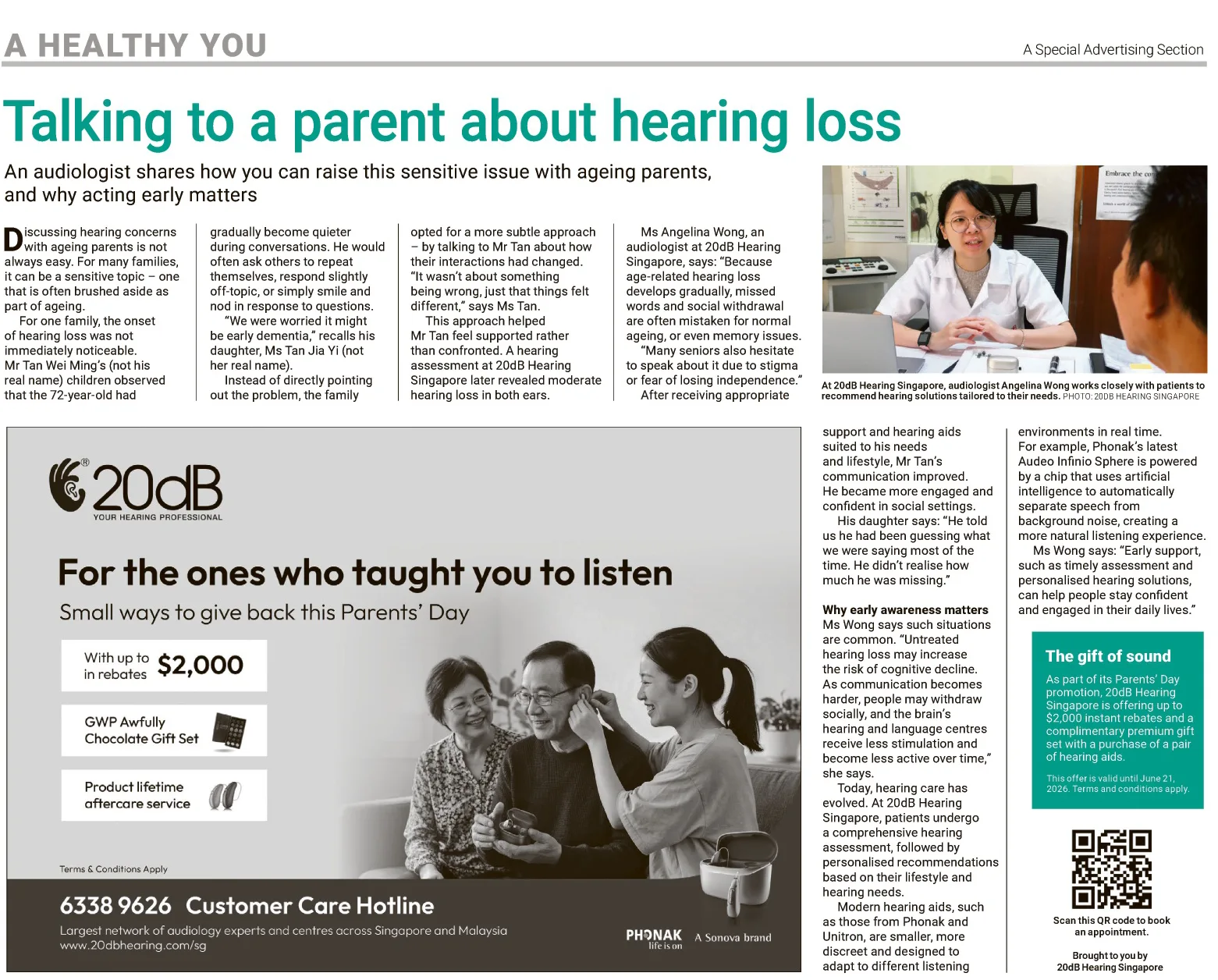
*This article is officially published on The Straits Times newspaper (6 May 2026).