





Taking Your Parent for a Hearing Test in Malaysia: A Family Guide
You've noticed it for months now. Maybe years.
The TV volume is creeping up. The "hah?" after every sentence. The slow withdrawal from family dinners because following conversation across a noisy table became too exhausting.
You know your parents need a hearing test. They probably know it, too. But nobody's said it out loud yet, because admitting it feels like admitting something bigger. That they're getting older, things are changing, and that they need help.
Getting a hearing test is not a big deal. It's painless, it takes under an hour, and it gives you real answers instead of guesses. The hard part isn't the test. It's getting them through the door.
This guide is for you: the son or daughter who's ready to make that happen.
Why they keep saying "I can hear fine"
Let's get this out of the way first. Your parents are not stubborn just to annoy you. Well, maybe a little. But there's a real reason they resist.
Hearing loss in older adults almost always happens gradually. The National Institute on Deafness and Other Communication Disorders describes age-related hearing loss as something that comes on gradually, usually in both ears, and can easily go unnoticed. It creeps so slowly that the brain adapts, fills gaps, and creates the illusion that everything is normal. According to the World Health Organization's report on hearing loss, over 25% of people aged 60 and above live with disabling hearing loss globally. In many cases, they've been compensating for years without realising it.
There's also pride. Nobody wants to feel like they're losing a faculty. And in Malaysian culture especially, there's an unspoken expectation that elders stay strong, stay sharp, stay in charge.
So, when you bring it up, do it gently. Frame it as a health checkup: because that's exactly what it is. You don't wait for chest pain to check your blood pressure. The same logic applies here.
What actually happens at an elderly hearing test
If your parents are imagining some intimidating medical procedures, you can put their minds at ease. A hearing test for elderly patients in Malaysia is straightforward and completely painless.
Here's what a typical session at an audiology clinic looks like:
-
Case history discussion: The audiologist asks about medical background, medications, noise exposure, and daily listening challenges. This conversation matters. It helps them understand the full picture.
-
Otoscopy: They look inside the ears with a small handheld device. They're checking for wax buildup, infections, or anything unusual.
-
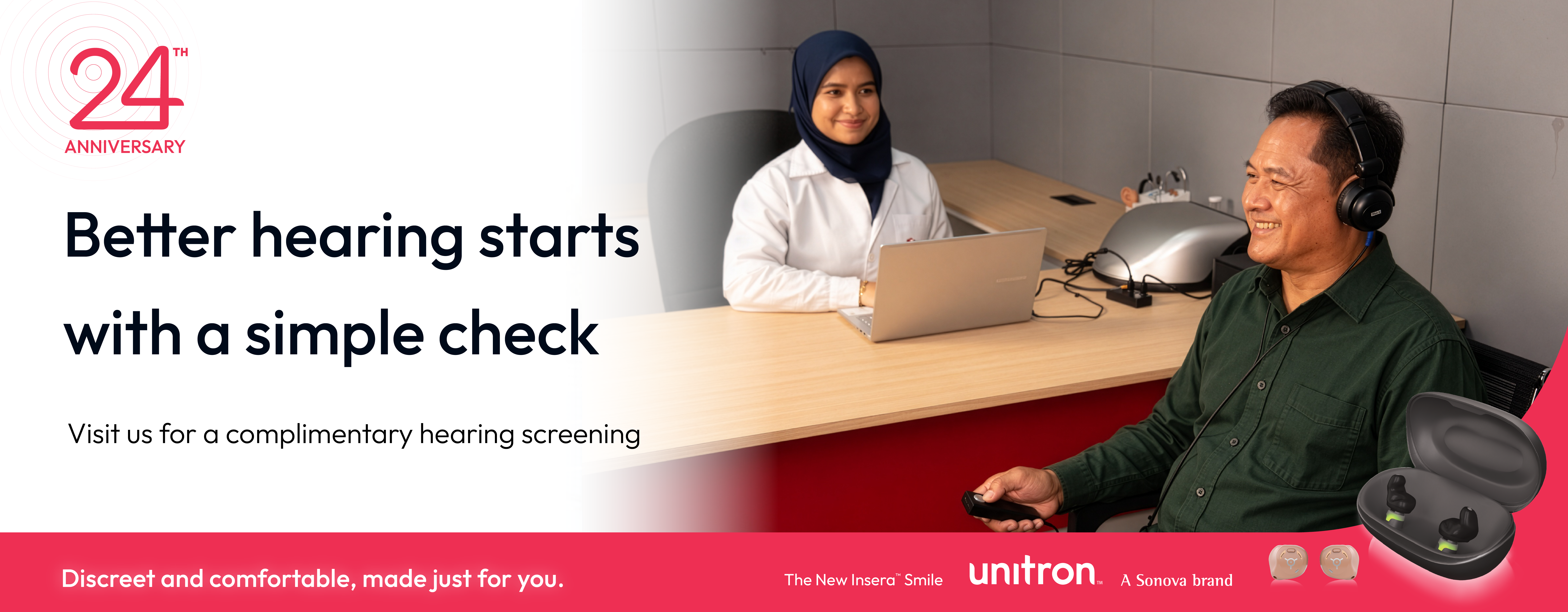
Pure tone audiometry: Your parent wears headphones and responds when they hear beeps at different pitches and volumes. This is the core test. It maps out exactly which sounds they can and can't hear.
-
Results review: The audiologist may carry out any other tests that are needed before reviewing the results. Everything then gets plotted on a chart called an audiogram, and the audiologist walks you through it right there and then.
The whole process usually takes 30 minutes to an hour. No needles. No discomfort. Just listening and responding.
If your parent has mobility issues or health conditions that make clinic visits difficult, some providers like 20dB Hearing offer home visits for hearing tests and hearing aid trial fittings, which can make the experience far less stressful for everyone involved.
How to prepare: and the one mistake families make in the room
A little preparation goes a long way. Before the appointment:
-
Bring a list of their medications. Some drugs affect hearing. The audiologist needs to know.
-
Write down specific situations where you've noticed them struggling. "Dad can't hear the grandchildren" is more useful than "he can't hear well."
-
Choose a clinic with experience in geriatric patients. Not every audiologist specialises in elderly care, and patience matters.
Now, here's the mistake almost every loving family member makes.
You answer them.
The audiologist asks your parents a question, and before they can respond, you jump in with the answer. It comes from a good place. You want to help, you want to be efficient, and you know the answer already.
But the audiologist needs to hear from your parents. How they describe their experience, how quickly they process the question, and whether they misunderstand certain words: all of this is diagnostic information. It tells the audiologist things a hearing test alone cannot.
Your job in the room is to be supportive, present, and quiet. Let them answer. Add context only when the audiologist asks you directly. Think of yourself as the backup singer, not the lead vocalist.
|
Do this |
Avoid this |
|
Sit where your parent can see you for reassurance |
Hover over them or the audiologist |
|
Let your parent answer all questions first |
Jump in with answers immediately |
|
Share observations when asked |
Contradict or correct your parent in front of the audiologist |
|
Take notes on the audiologist's recommendations |
Record the session without permission |
|
Ask questions about next steps |
Push for decisions on the spot |
What the results mean, and what comes next
After the test, the audiologist will show you the audiogram. It looks like a graph with dots connected by lines. Here's a simplified way to read it:
-
Dots near the top of the chart mean good hearing at that pitch.
-
Dots dropping toward the bottom mean hearing loss at that pitch.
-
The pattern of the drop tells the audiologist what type of hearing loss it is.
Most age-related hearing loss follows a predictable pattern: hearing is better at low pitches and poorer at higher pitches. This is why your parents might hear your voice but do not understand your words clearly. Consonant sounds like "s," "f," and "th" live in those higher frequencies. Without them, speech sounds mumbled. Johns Hopkins Medicine lists trouble telling apart high-pitched sounds such as "s" and "th" as a common symptom.
The audiologist will classify the loss as mild, moderate, severe, or profound. They'll also tell you whether it's:
-
Sensorineural: related to the inner ear or nerve (most common in aging)
-
Conductive: related to the outer or middle ear (sometimes treatable medically)
-
Mixed: a combination of both
Not every result led to hearing aids. Sometimes the answer is wax removal. Sometimes it's a medical referral. Sometimes it's hearing aids combined with communication strategies for the whole family.
The point is: you can't know until you test.
Free hearing screenings and where to start
Some organisations in Malaysia offer free hearing screening events for seniors, particularly during awareness campaigns tied to World Hearing Day each March. These screenings are a good starting point, but they're exactly that, a starting point. A screening tells you whether further testing is needed. It doesn't replace a full diagnostic assessment by a certified audiologist.
If your parent "passes" a free screening, but you still notice daily struggles, trust what you see at home. Screenings test basic hearing ability in a quiet room. Real life has background noise, competing voices, and the acoustic chaos of a Malaysian kopitiam at lunchtime.
For a complete picture, a hearing test conducted by a certified audiologist is what you want. It's thorough, it's personalised, and it gives you a clear path forward: whether that means intervention now or monitoring over time.
Taking your parents for a hearing test isn't about proving something wrong with them. It's about giving them the information they need to stay connected: to you, to the grandchildren, to the conversations that make life feel full.
You've already done the hardest part by caring enough to research this. The next step is simple.
Book an accompanied hearing assessment at 20dB Hearing and bring your parents along. You'll both walk out with answers. And answers, no matter what they are, beat guessing every single time.