

Noise-Induced Hearing Loss Treatment: What Actually Works (and What Doesn't)
You didn't notice it at first.
Maybe you started turning up the TV a little louder. Maybe you asked your colleague to repeat themselves, twice. Maybe there's a faint ringing in your ears that wasn't there before, and it shows up uninvited every night when the room goes quiet.
Now you're Googling "noise induced hearing loss treatment" at 1 a.m., hoping someone on the internet will tell you it's fixable.
Here's an honest answer, and it's not the one most people want to hear: it's the one that can save the hearing you have left.
What noise-induced hearing loss actually does to your ears
Deep inside your inner ear sits a tiny, snail-shaped organ called the cochlea. Lining the inside of it are thousands of microscopic hair cells. These hair cells are the translators between sound waves and your brain. They pick up vibrations and convert them into electrical signals your brain reads as speech, music, laughter, car horns, everything.
When you're exposed to loud sound (a factory floor, a packed concert, heavy machinery, even earbuds cranked to max), those hair cells get battered. Think of them like grass under heavy foot traffic. A little pressure, and they spring back. Too much, too often, and they flatten permanently.
Here's the critical part. According to the National Institute on Deafness and Other Communication Disorders (NIDCD), we are born with a limited number of hair cells in each ear. They do not regenerate. Once they're damaged beyond repair, they're gone.
No medication brings them back. No surgery replants them.
That's what makes noise-induced hearing loss different from, say, an ear infection. An infection heals. Dead hair cells don't.
Symptoms you shouldn't ignore
Noise-induced hearing loss is sneaky. It doesn't announce itself with pain or dramatic sudden deafness. It creeps in. Most people don't realise they have it until significant damage has already occurred.
Here's a quick checklist. If two or more of this sound familiar, pay attention:
-
Muffled hearing after loud events: sounds seem "dulled" for hours or even days after a concert, construction shift, or loud commute
-
Difficulty following conversations in noisy places like restaurants or mamak stalls
-
Frequently asking people to repeat themselves, especially women and children (higher-pitched voices go first)
-
Tinnitus: a persistent ringing, buzzing, or hissing in your ears, especially in quiet rooms
-
Turning up the volume on your phone, TV, or car stereo higher than you used to
-
Feeling exhausted after social events because you've been straining to hear all evening
That last one surprises people. Listening to fatigue is real. When your brain has to work overtime to fill in the gaps left by damaged hearing, it drains you.
If you ticked even two boxes on that list, it's worth getting a proper adult hearing assessment. Not an online quiz, but a real diagnostic test with a certified audiologist.
Can noise-induced hearing loss be reversed?
This is the question everyone asks. And the honest answer is: no, it cannot be reversed.
Not yet, anyway. There is promising research into hair cell regeneration. In a 2019 proof-of-concept study by researchers at Harvard Medical School and Massachusetts Eye and Ear, activating two molecular signals in adult mice led to hair cell-like cells growing in the inner ear. But this is early-stage research, and there are still no treatments available today that regrow hair cells.
So if someone online is selling you a supplement, an ear drop, or a "sound therapy device" that claims to reverse noise-induced hearing loss, save your money. The science simply isn't there yet.
But (and this is important) that doesn't mean nothing can be done.
The damage you already have may be permanent. The damage you haven't sustained yet is entirely preventable. And the hearing you still have? It can be managed, supported, and protected far better than you might think.
That gap between "nothing can fix it" and "nothing can be done" is where real treatment lives.
Treatment options that actually help
Once noise-induced hearing loss is confirmed through a proper audiometric evaluation, there are effective ways to manage it. None of them reverse the damage. All of them improve your daily life.
Hearing aids
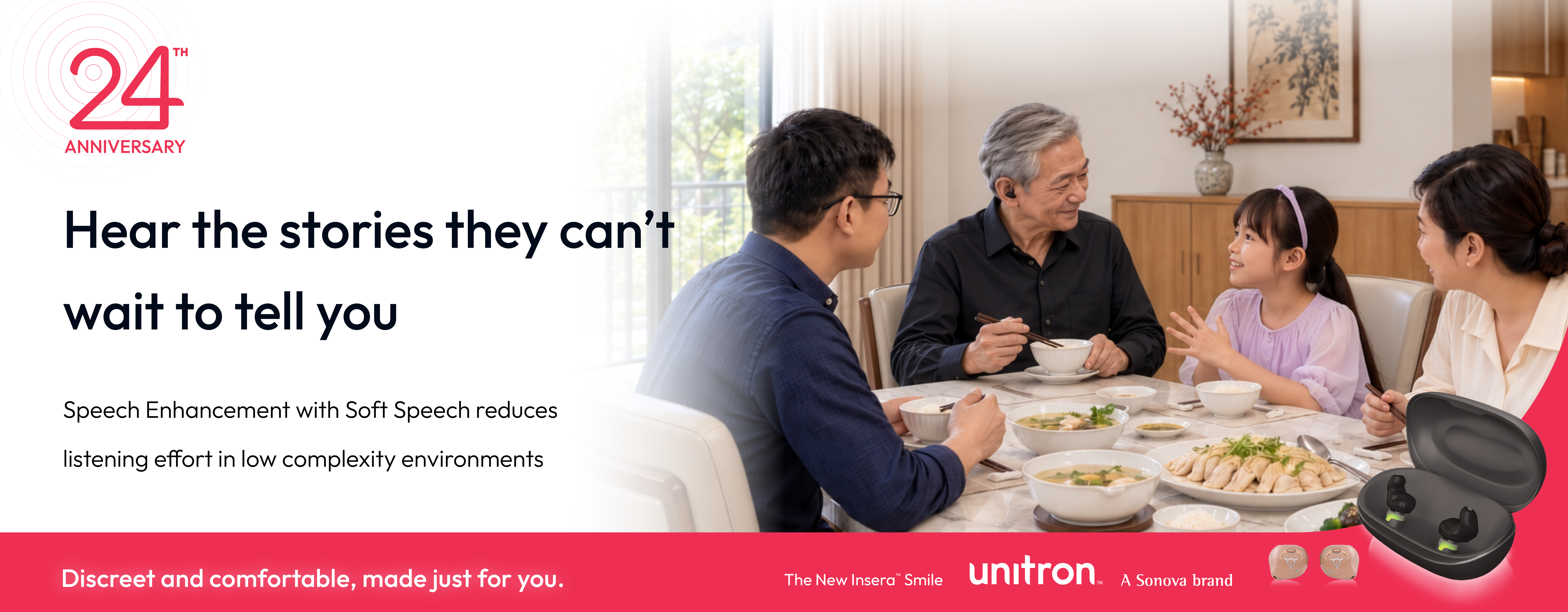
Modern hearing aids are nothing like the bulky beige things your grandfather wore. Today's devices are small, discreet, and remarkably intelligent. They amplify the specific frequencies you've lost: which, for most noise-induced cases, means the higher pitches that make speech clear and crisp.
Many connect to your smartphone via Bluetooth. Some adjust automatically based on your environment. WHO recommends addressing hearing loss as early as possible. Hearing aids are one of the rehabilitation options that can help people with hearing loss communicate and participate more fully in daily life.
Tinnitus management
If that ringing or buzzing in your ears is driving you mad, you're not alone. Tinnitus is one of the most common companions of noise-induced hearing loss. There are proven ways to manage it. If tinnitus comes on suddenly, see an ENT specialist straight away, and seek emergency care if it comes with sudden hearing loss, dizziness or facial weakness.
These include sound therapy, cognitive behavioural techniques, and hearing aids with tinnitus support features. 20dB Hearing offers a dedicated tinnitus assessment and management programme that can help you regain control over the noise in your head.
Communication strategies and rehabilitation
An audiologist doesn't just test your hearing and send you home. A good one helps you develop strategies: positioning yourself in conversations, using visual cues, optimising your listening environments. Small changes, big impact.
How to prevent noise-induced hearing loss from getting worse
Prevention isn't just for people who haven't lost hearing yet. If you already have some damage, preventing further loss is the single most important thing you can do.
Here's what works:
-
Wear hearing protection. Foam earplugs, custom-moulded earplugs, or over-ear defenders: use them in any environment above 85 decibels. That includes factories, workshops, live music venues, and even prolonged motorcycle rides.
-
Follow the 60/60 rule for earbuds. No more than 60% volume for no more than 60 minutes at a time.
-
Take listening breaks. If you work in a loud environment, step away to somewhere quiet for 5–10 minutes every hour. Your hair cells need recovery time.
-
Get your hearing tested regularly. This is the one most people skip, and the one that matters most.
The reason regular testing matters is simple. Noise-induced hearing loss is gradual. You won't feel it happening. By the time you notice symptoms, you've likely already lost more than you realise. A baseline hearing test followed by annual check-ups catches changes early, when intervention is most effective.
|
Noise source |
Approximate decibels |
Safe exposure time |
|
Normal conversation |
60 dB |
Unlimited |
|
Heavy traffic / busy restaurant |
80–85 dB |
8 hours |
|
Motorcycle / lawn mower |
90–95 dB |
1–2 hours |
|
Live concert / nightclub |
100–110 dB |
Under 15 minutes |
|
Firecrackers / gunfire |
140+ dB |
Immediate damage |
Exposure times are based on the NIOSH recommended limit of 85 dBA averaged over an eight-hour day, with the safe exposure time halved for every 3 dBA increase.
The window is open, but it won't stay open forever
Here's what I want you to take away from this article.
You can't undo the damage that's been done. That's the hard truth. But you can stop it from getting worse. You can find out exactly where your hearing stands right now. And you can start managing it in a way that gives you back the clarity, confidence, and connection you've been quietly losing.
The worst thing you can do is wait. Every month of unprotected exposure, every skipped test, every "I'll deal with it later" narrows the window.
If you're in Malaysia and you've been putting this off, book a hearing test with a certified audiologist at 20dB Hearing. It's quick, it's painless, and it gives you the one thing Google can't: a real answer about your hearing, from someone qualified to give it.
Your ears can't heal themselves. But they're asking for help.
Maybe it's time to listen.
References
-
National Institute on Deafness and Other Communication Disorders (NIDCD): Noise-induced hearing loss