



Pure Tone Audiometry: The Complete Guide to the PTA Test
Pure Tone Audiometry: What It Is, What It Costs, and Where to Get Tested in Malaysia
You know that annoying moment when you ask someone to repeat themselves for the third time?
And you laugh it off. "Sorry, noisy in here." But deep down, a small voice whispers: Is something wrong with my hearing?
That small voice is worth listening to. Because the answer is surprisingly easy to find. It starts with one test—a pure tone audiometry test. It's painless. It takes about 30 minutes. And it gives you a crystal-clear picture of exactly what your ears can and can't hear.
Let's walk through everything you need to know.
What Pure Tone Audiometry Actually Measures
Pure tone audiometry—PTA for short—is the gold standard hearing test used by audiologists worldwide. It measures the softest sounds your ears can detect across a range of pitches, from deep bass tones to high-frequency sounds.
Think of it like an eye chart, but for your ears. Instead of reading smaller and smaller letters, you're listening for quieter and quieter beeps.
The test checks two things:
- Air conduction — Sound travels through your ear canal, eardrum, and middle ear bones into your inner ear. This tests the entire hearing pathway.
- Bone conduction — A small vibrating device placed behind your ear sends sound directly to your inner ear, bypassing the outer and middle ear completely.
Why does this matter? Because comparing the two results tells the audiologist where the problem is. If air conduction is poor but bone conduction is normal, the issue is in your outer or middle ear. That's called conductive hearing loss, and it's often treatable—sometimes even reversible.
If both results are equally poor, the problem is in the inner ear or auditory nerve. That's sensorineural hearing loss. It's more permanent, but highly manageable with the right hearing aids.
According to the World Health Organization's fact sheet on deafness and hearing loss, over 1.5 billion people globally live with some degree of hearing loss. By 2050, that number could hit 2.5 billion. Early detection through tests like PTA makes a real difference in outcomes.
The Full Pure Tone Audiometry Test Procedure, Step by Step
No needles. No pain. No fasting required. Here's exactly what happens:
Before the test: Your audiologist will ask about your hearing history. Any ear infections? Noise exposure at work? Family history of hearing loss? Ringing in your ears? This background helps them interpret your results more accurately.
During the test:
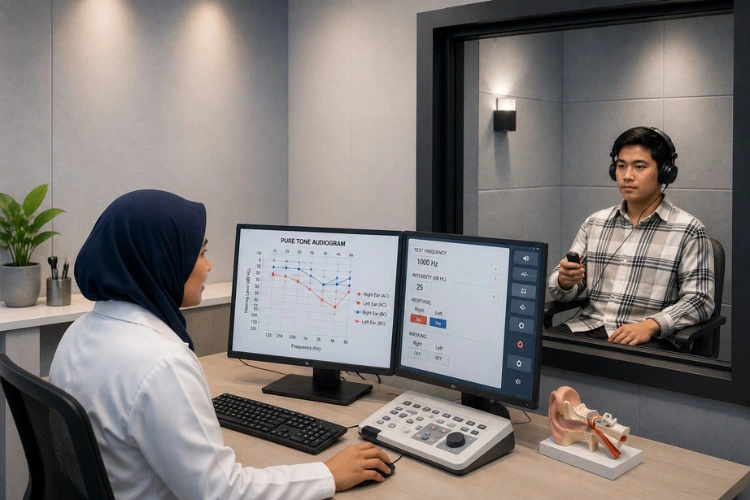
- You sit in a soundproof booth or quiet room and put on a set of headphones.
- The audiologist plays a series of pure tones—single-frequency beeps—at different pitches (usually 250 Hz to 8,000 Hz).
- Each tone starts soft and gets gradually louder. The moment you hear it, you press a button or raise your hand.
- They test one ear at a time.
- Next comes bone conduction. A small device called a bone oscillator is placed on the mastoid bone behind your ear. The process repeats—tones at various pitches, and you respond when you hear them.
That's it. The whole thing takes 20 to 30 minutes. Most people describe it as surprisingly relaxing.
After the test: Your audiologist plots the results on a chart called an audiogram. This is where the real insight happens.
How to Read Your Audiogram Results
An audiogram looks like a graph. The horizontal axis shows frequency (pitch) from low to high. The vertical axis shows intensity (loudness) in decibels, from soft at the top to loud at the bottom.
Your results are plotted as two lines—one for each ear. Here's what the numbers mean:
| Hearing Level (dB) | Classification |
|---|---|
| 0–25 dB | Normal hearing |
| 26–40 dB | Mild hearing loss |
| 41–55 dB | Moderate hearing loss |
| 56–70 dB | Moderately severe hearing loss |
| 71–90 dB | Severe hearing loss |
| 91+ dB | Profound hearing loss |
A few things to watch for:
- A dip at 4,000 Hz — This is the classic signature of noise-induced hearing loss. Common in people who work in factories, attend concerts frequently, or use earbuds at high volume.
- A gap between air and bone conduction lines — This "air-bone gap" signals conductive hearing loss, which often has medical or surgical solutions.
- Asymmetry — If one ear is significantly worse than the other, your audiologist may recommend further investigation.
The audiogram is a powerful tool. But it needs a trained professional to interpret it properly. Online hearing screeners can give you a rough idea, but they can't replace a proper PTA conducted by a certified audiologist in a controlled environment.
PTA vs Other Hearing Tests
Pure tone audiometry isn't the only hearing test out there. So how does it stack up?
| Test | What It Does | Best For |
|---|---|---|
| Pure Tone Audiometry (PTA) | Measures the softest sounds you can hear at each pitch. | Adults and children (5+) with suspected hearing loss. |
| Speech Audiometry | Tests how well you understand spoken words. | Assessing real-world hearing ability. |
| Tympanometry | Measures eardrum movement and middle ear pressure. | Detecting fluid, infections, or eardrum problems. |
| OAE (Otoacoustic Emissions) | Records sounds produced by the inner ear. | Newborn hearing screening. |
| ABR (Auditory Brainstem Response) | Measures nerve signals from ear to brain. | Newborns or patients who can't respond to beeps. |
Most comprehensive hearing assessments start with PTA as the foundation, then add other tests based on what the audiologist finds. Think of PTA as the main course—everything else is a side dish ordered as needed.
For newborns and infants who can't press a button or raise a hand, 20dB Hearing offers specialised newborn hearing assessments and children's hearing assessments that use objective tests like OAE and ABR instead.
Pure Tone Audiometry Price in Malaysia and Where to Get Tested
Let's talk ringgit.
The price of a pure tone audiometry test in Malaysia typically ranges from RM50 to RM200 at private audiology clinics, depending on whether it's a standalone PTA or part of a full hearing assessment package.
At 20dB Hearing, a comprehensive hearing test by certified audiologists includes PTA along with other assessments tailored to your specific concerns. You're not just getting a beep test—you're getting a full evaluation by a qualified professional who can explain exactly what your results mean and what to do next.
Looking for pure tone audiometry near you? 20dB Hearing has over 35 branches across Malaysia—from Kuala Lumpur and Petaling Jaya to Penang, Johor Bahru, Kuching, and beyond. Chances are, there's one close to your home or office.
Can't make it to a branch? They even offer home visit hearing tests for elderly patients or anyone with mobility challenges.
Here's the thing about hearing loss. It's slow. So slow you don't notice it happening. You turn the TV up one notch. Then another. You start reading lips without realising it. You avoid phone calls because voices sound mumbled.
By the time most people take action, they've been living with reduced hearing for years. And research shows that untreated hearing loss is linked to cognitive decline, social isolation, and even increased risk of dementia.
A 30-minute PTA test can change all of that.
Book your hearing assessment at 20dB Hearing today. Walk in with a question. Walk out with answers—and a plan.